Why are we here?
Secular Viewpoint
“What is the meaning of Life?” is the classic question that many philosophers and scientists have struggled with all through history. As recorded in Wikipedia –
“There have been many proposed answers to this question from many different cultural and ideological backgrounds. The search for life’s meaning has produced much philosophical, scientific, theological, and metaphysical speculation throughout history. Different people and cultures believe different things for the answer to this question.”
Despite all this effort over the years, there does not appear to be one answer which even has a consensus approval.
Christian Viewpoint
The first question and answer of the Westminster Shorter Catechism asks a similar question to the one above but also supplies an answer–
“Q.1 – What is the chief end of Man?
A.1 – Man’s chief end is to glorify God and enjoy Him forever.”
In more modern language it might say: –
“Q.1 – What is the main purpose for which man is made?
A.1 – The main purpose for which man is made is to glorify God, and to enjoy Him forever.”
As with all the catechism answers, the answer given is based on Scripture passages, after much deliberation by theologians and laymen in the 1640s. It basically says that God made us for the purpose of glorifying Him. We cannot add to God’s glory, but we can glorify Him by doing everything in our life in loving service to Him. Then we can experience real joy in our lives now and joy that never ends when this life finishes.
What does Jesus say?
Jesus was never directly asked about the meaning of life, but he was asked something similar as is recorded in Matthew 22 v 36 – 38: –
“Teacher, which is the greatest commandment in the Law?
Jesus replied: “Love the Lord your God with all your heart and with all your soul and with all your mind. This is the first and greatest commandment.”
Jesus did not stop there, he continued in verse 39 to say: –
“And the second is like it: Love your neighbour as yourself”.
So, taking each of these great commandments in turn, what else did Jesus say on the matter?
1. How should we “Love the Lord your God….”?
OBEDIENCE and loving Jesus seem to go hand in hand, certainly as recorded in John. JESUS SAID: –
| Jn 14 | 15 | If you love me, you will obey what I command |
| Jn 14 | 21 | Whoever has my commands and obeys them, he is the one who loves me |
| Jn 14 | 23 | If anyone loves me, he will obey my teaching |
| Jn 14 | 10 | If you obey my commands, you will remain in my love, just as I have obeyed my Father’s commands and remain in his love. |
This implies that we must study the bible to find God’s commands and discover his intentions for our life; and then obey.
Obedience should not be difficult or onerous. Indeed, obedience should be a source of JOY, which ties back to the answer provided earlier by the catechism (“… and enjoy Him…”).
| Ps 1 | 2 | Delight is in the law of the Lord |
| Ps 19 | 8 | The precepts of the Lord are right, giving joy to the heart |
In “My Rock, My Refuge”, Timothy Keller provides a devotional reading from the psalms for each day of the year. The following two entries show the relationship between Obedience and Joy: –
| Nov | 13 | “JOY without OBEDIENCE is frivolity; OBEDIENCE without JOY is moralism” quoting Motyer |
| Jul | 18 | “The ultimate purpose of OBEDIENCE is JOY, the fulfilment of knowing the God you were built to love.” |
2. How should we “Love your neighbour as yourself”?
Jesus gives very direct advice on how to love other people by splitting “neighbours” into three different categories. The following scriptures are all recorded words of Jesus.
2.1 Christian brothers and sisters
| Jn 13 | 34-35 | Love one another. As I have loved you, so you must love one another. By this all men will know that you are my disciples if you love one another. |
| Jn 15 | 12 | My command is this: Love each other as I have loved you. |
2.2 Enemies
| Matt 5 | 44 | Love your enemies and pray for those who persecute you. |
| Luke 6 | 27 | Love your enemies, do good to those who hate you. |
2.3 Others
| Matt 7 | 12 | So in everything, do to others what you would have them do to you, for this sums up the Law and the Prophets. |
In Summary
Mankind exists to glorify God. This love of God should extend to loving all other people, whether Christians or non-Christians.
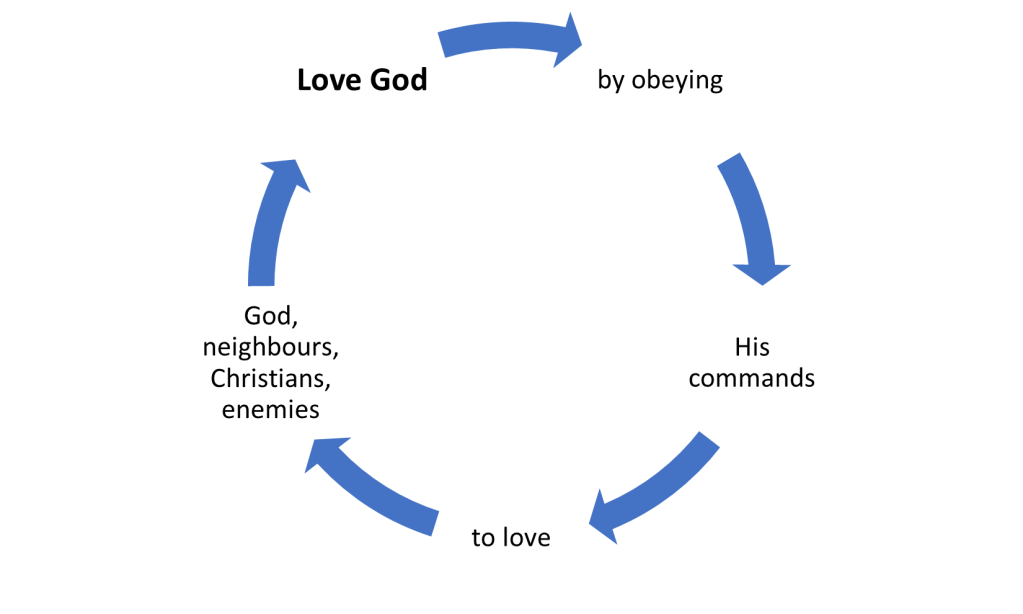
Next time we look at the practicalities of loving God.
 Christian Discipleship
Thank you a great start to your blog.
LikeLike
This is the clearest description of the Christian concept of the meaning that I have seen. Thank you for sharing this!
LikeLike